

Creating high-quality content consistently is one of the biggest challenges for bloggers, marketers, social media managers, YouTubers, and small businesses. AI writing tools can help with brainstorming, research, drafting, editing, repurposing, and improving content—but the best tool depends on what you actually need to create.
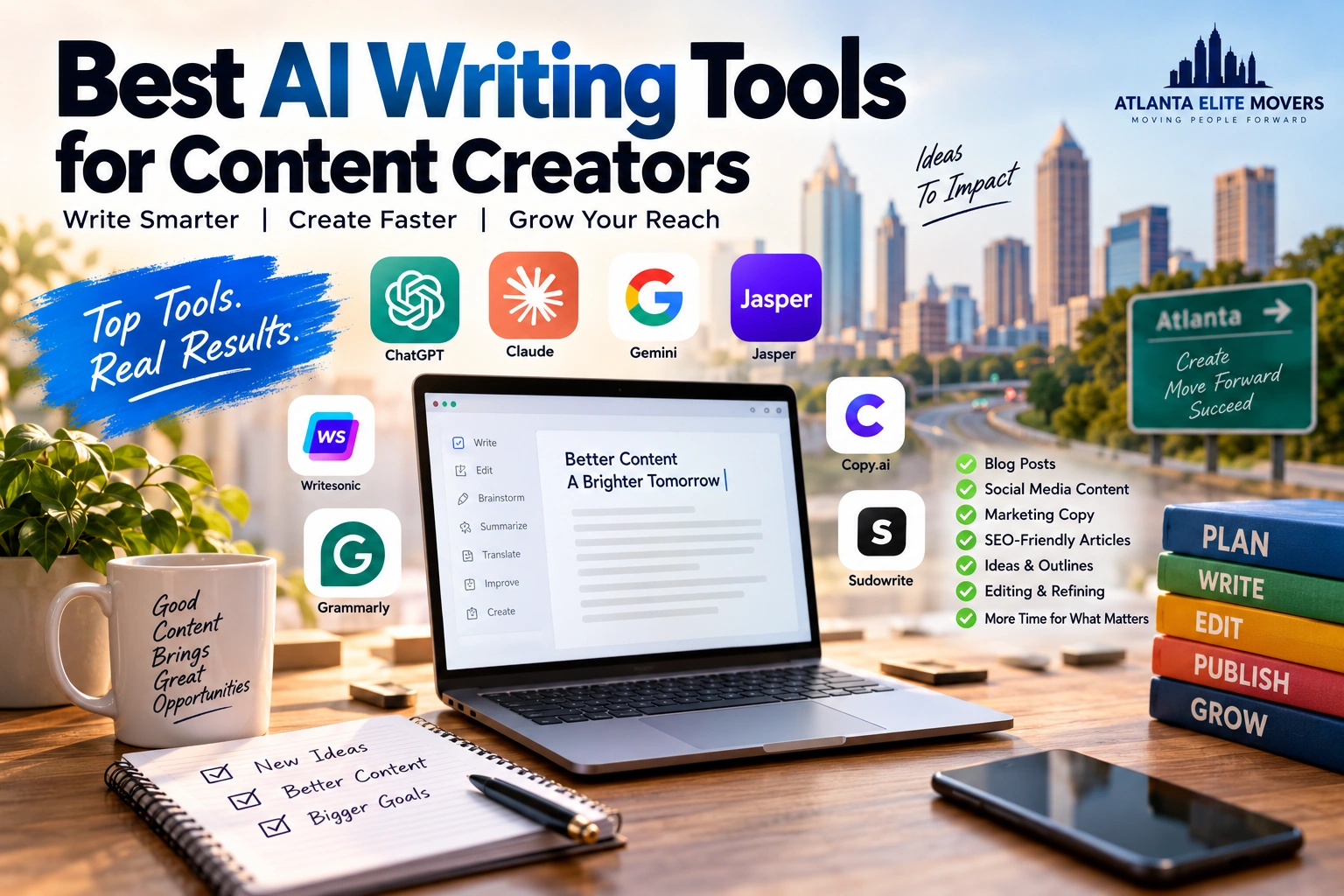
The best AI writing tools for content creators in 2026 include ChatGPT, Claude, Gemini, Jasper, Writesonic, Grammarly, Copy.ai, and specialized tools such as Sudowrite. The right choice depends on whether your priority is long-form writing, SEO, brand consistency, editing, research, or creative writing. If you want a broader roundup of AI tools beyond writing specifically, see our guide to the Best AI Tools to Try in 2026.
Quick Answer: What Is the Best AI Writing Tool for Content Creators?
For most content creators, ChatGPT is one of the most versatile overall options because it can help with brainstorming, outlining, drafting, rewriting, research-oriented workflows, and adapting content for different audiences. OpenAI recommends a workflow of planning, drafting, revising, and packaging rather than treating AI output as a finished article.
However, there is no single best AI writing tool for everyone.
| AI Writing Tool | Best For | Main Strength |
|---|---|---|
| ChatGPT | General content creation | Versatility and brainstorming |
| Claude | Long-form writing | Natural prose and detailed drafting |
| Gemini | Google-focused workflows | Integration with Google’s ecosystem |
| Jasper | Marketing teams | Brand voice and marketing workflows |
| Writesonic | SEO content | SEO-focused content workflows |
| Grammarly | Editing | Grammar, clarity, and rewriting |
| Copy.ai | Marketing workflows | Content and go-to-market workflows |
| Sudowrite | Fiction writers | Creative and storytelling assistance |
The AI writing market is changing quickly, so features and pricing should always be checked directly with the provider before purchasing. Recent 2026 comparisons also show that several specialized tools have moved beyond simple text generation into brand management, SEO, workflow automation, and AI-search visibility. For a look at tools spanning categories beyond writing, our Best AI Tools to Try in 2026 guide covers a wider range of options.
What Should Content Creators Look for in an AI Writing Tool?
Before choosing an AI writing platform, consider what type of content you produce.
The most useful features typically include:
- Content brainstorming
- Blog outlining
- Long-form drafting
- Rewriting and editing
- Brand voice controls
- SEO assistance
- Research support
- Content repurposing
- Social media copy generation
- Email writing
- Collaboration features
- Integration with other applications
A tool that is excellent for writing advertisements may not be the best option for producing a 2,000-word educational article. Likewise, a powerful general AI assistant may not provide the specialized workflow features a large marketing team needs.
1. ChatGPT — Best Overall AI Writing Assistant
ChatGPT is a strong choice for creators who want one flexible tool for multiple types of writing.
It can help generate ideas, create outlines, draft content, rewrite paragraphs, change tone, summarize information, and turn one piece of content into different formats. OpenAI’s current writing guidance recommends giving the model clear context, audience information, constraints, and the desired format, then reviewing the output rather than treating it as final authority.
Best uses for ChatGPT
- Blog brainstorming
- Content outlines
- Blog drafts
- Social media posts
- Email campaigns
- Headlines
- Content repurposing
- Editing
- FAQ creation
- Content strategy
For example, a local business could turn one article into a blog post, Facebook post, Instagram caption, Google Business Profile post, FAQ section, and email newsletter.
That makes a general-purpose AI assistant particularly useful for small businesses that do not have a large content team.
2. Claude — Best for Long-Form Writing
Claude is another strong option for creators who regularly work with longer documents and detailed writing assignments.
It can be useful when the priority is producing readable long-form prose, analyzing substantial amounts of information, or refining an existing draft.
Claude may be a good choice for:
- Long-form articles
- Reports
- Guides
- Thought-leadership content
- Content editing
- Research organization
- Detailed drafts
The important point is that AI-generated writing should still receive human review. Even strong language models can misunderstand context, introduce factual errors, or produce generic claims.
3. Gemini — Useful for Google-Centered Content Workflows
Gemini can be particularly useful for creators who already work heavily within Google’s ecosystem.
It can assist with brainstorming, drafting, summarizing, rewriting, and other common writing tasks.
Gemini can help with:
- Blog ideas
- Marketing copy
- Email drafts
- Summaries
- Social content
- Research assistance
- Content planning
If your workflow already relies heavily on Google products, ecosystem compatibility may be an important factor when choosing an AI writing assistant.
4. Jasper — Best for Marketing Teams and Brand Voice
Jasper is designed more specifically around marketing content than general-purpose AI assistants.
Its biggest advantage is useful for organizations that need consistent brand messaging across multiple pieces of content.
Recent comparisons of the 2026 AI writing market continue to position Jasper around marketing teams, brand voice, and structured content workflows rather than simply generating one-off paragraphs.
Jasper may be useful for:
- Marketing teams
- Brand campaigns
- Advertising copy
- Content marketing
- Social media campaigns
- Brand-consistent writing
For a larger organization producing content across several channels, brand consistency can be more valuable than simply generating text quickly.
5. Writesonic — Best for SEO-Focused Content Workflows
Writesonic is particularly relevant for creators whose main objective is publishing search-focused content.
Its positioning has increasingly expanded toward SEO and AI-search visibility rather than functioning solely as a basic AI article generator.
Writesonic can be useful for:
- SEO articles
- Blog content
- Content optimization
- Search-focused research
- Content planning
- AI-search visibility workflows
However, an SEO tool should not replace actual editorial judgment. Search engines increasingly reward useful, trustworthy content rather than pages created simply to target keywords.
6. Grammarly — Best for Editing and Refinement
Grammarly is particularly useful when you already have content and want to improve its clarity, grammar, tone, and readability.
Instead of asking an AI to create an entire article from nothing, creators can use an editing tool to refine their own writing.
Grammarly is useful for:
- Grammar correction
- Sentence improvement
- Clarity
- Tone
- Professional writing
- Email editing
- Content polishing
This makes it complementary to other AI writing tools rather than necessarily replacing them.
7. Copy.ai — Best for Marketing and Workflow Automation
Copy.ai has evolved beyond the simple “AI copywriter” model and increasingly focuses on marketing and go-to-market workflows.
It can be useful for organizations that need to produce multiple forms of marketing content repeatedly.
Potential use cases include:
- Marketing copy
- Sales content
- Campaign workflows
- Product messaging
- Short-form content
- Repetitive marketing tasks
Recent 2026 comparisons describe Copy.ai as increasingly focused on GTM workflows rather than competing solely as a traditional blog-writing tool.
8. Sudowrite — Best for Fiction and Creative Writing
Not every content creator is writing SEO articles or marketing copy.
For fiction writers, novelists, and storytellers, specialized creative-writing tools can provide a different set of features.
Sudowrite is designed specifically around creative and fiction writing, making it a more specialized choice than general business-oriented AI writing platforms.
Which AI Writing Tool Is Best for Different Types of Creators?
The best tool depends on your workflow.
| Creator Type | Recommended Starting Point |
|---|---|
| Blogger | ChatGPT or Writesonic |
| SEO Content Creator | Writesonic or ChatGPT |
| Marketing Team | Jasper |
| Social Media Manager | ChatGPT or Jasper |
| Fiction Writer | Sudowrite |
| Editor | Grammarly |
| Small Business | ChatGPT |
| Research-Heavy Writer | ChatGPT or a research-focused workflow |
| Large Content Team | Jasper or another team-focused platform |
| Beginner | ChatGPT |
These recommendations should be treated as starting points rather than universal rankings. The best platform depends on your content volume, budget, workflow, editing requirements, and publishing goals. If you’re comparing options across categories beyond writing tools alone, check out our Best AI Tools to Try in 2026.
Are AI Writing Tools Good for SEO?
Yes—but using AI does not automatically make content SEO-friendly.
A good SEO article needs to satisfy the searcher’s intent, cover the topic comprehensively, demonstrate expertise and trustworthiness, and provide information that is genuinely useful, in line with Google’s own guidance on optimizing for generative AI search features.
AI can help with:
- Keyword research ideas
- Topic clustering
- Content outlines
- Related questions
- Drafting
- Internal-link ideas
- Content refreshing
- Meta descriptions
- Title ideas
- FAQ generation
But creators should still verify important facts and edit the final article.
OpenAI’s own writing guidance recommends treating AI output as a draft that should be reviewed, particularly when specific facts, numbers, or policies are involved.
Can AI-Generated Content Rank on Google?
AI-generated content can appear in search results, but simply generating a large amount of AI content is not an SEO strategy. Google has stated directly that appropriate use of AI or automation is not against its guidelines, but using it primarily to manipulate rankings violates its spam policies.
The better approach is:
Research → Plan → Draft → Fact-check → Add expertise → Edit → Optimize → Publish → Update
The human contribution matters.
For example, instead of asking AI to create a generic article about moving companies, a moving company could provide original information about packing challenges, local moving considerations, common customer questions, preparation checklists, and practical experience.
That produces content with substantially more useful information than a generic AI-generated article.
How Can Content Creators Use AI Without Making Their Content Sound Generic?
The biggest mistake is publishing the first AI output without editing it.
A better workflow is:
Step 1: Start With Your Own Expertise
Give the AI your:
- Experience
- Examples
- Customer questions
- Opinions
- Data
- Processes
- Brand voice
Step 2: Ask AI to Organize the Information
Use AI to turn your knowledge into an outline.
Step 3: Generate a Draft
Let AI create the first version.
Step 4: Add Human Experience
Insert examples, original observations, unique data, and practical advice.
Step 5: Fact-Check
Verify statistics, dates, prices, regulations, product specifications, and other changing information.
Step 6: Optimize for Search and AI Answers
Add concise answers, descriptive headings, tables, FAQs, entities, and supporting sources.
Step 7: Edit Before Publishing
Remove repetitive, vague, or unnatural sentences.
This approach is much stronger than treating AI as a replacement for expertise.
How Can Local Businesses Use AI Writing Tools?
AI writing tools are particularly useful for local businesses because one topic can be transformed into many pieces of content.
For example, a moving company can create content around:
- Moving checklists
- Packing guides
- Local moving advice
- Moving costs
- Office relocation
- Loading and unloading
- Long-distance moving
- Moving-day preparation
- Storage tips
- Frequently asked customer questions
For a company such as Atlanta Elite Movers, AI can help turn the team’s existing knowledge into useful educational content for people planning a move in and around Atlanta.
The key is to provide genuine local knowledge rather than publishing generic AI content with a city name inserted into every paragraph.
How AI Writing Can Support an SEO Content Strategy
A practical content workflow for a local business can look like this:
Keyword research → Search intent → Content outline → AI-assisted draft → Expert review → Local information → Fact-checking → SEO optimization → Publishing → Updating
This approach creates a content library that can answer customers’ questions at different stages of the buying journey.
For example:
Awareness:
“What Should I Pack First When Moving?”
Research:
“How Much Does Moving Cost in Atlanta?”
Comparison:
“Local Movers vs DIY Moving: Which Is Better?”
Commercial:
“How to Choose a Moving Company in Atlanta”
Decision:
“What Questions Should You Ask a Moving Company Before Hiring Them?”
This type of topic cluster can help establish topical relevance around the broader moving subject.
Additional Resources
For readers who want to go directly to primary sources or try the tools mentioned in this guide:
- OpenAI: Writing with ChatGPT — official guidance on using ChatGPT for drafting, revising, and packaging written work.
- Google Search Central: Guidance about AI-generated content — Google’s official policy on AI content and search rankings.
- Google Search Central: Optimizing for generative AI features — official best practices for AI Overviews and AI Mode.
- ChatGPT (OpenAI)
- Claude (Anthropic)
- Gemini (Google)
- Jasper
- Writesonic
- Grammarly
- Copy.ai
- Sudowrite
Frequently Asked Questions
What is the best AI writing tool for content creators?
There is no single best tool for everyone. ChatGPT is a versatile starting point for many creators, while Jasper, Writesonic, Grammarly, and specialized platforms can be better suited to particular workflows.
Can AI writing tools create SEO-friendly blog posts?
Yes. AI can assist with research, outlines, drafting, keyword ideas, and optimization. However, SEO performance depends on the quality, usefulness, relevance, authority, and overall experience of the finished content—not simply whether AI was used.
Is ChatGPT good for content creation?
Yes. ChatGPT can assist with brainstorming, outlining, drafting, rewriting, editing, and adapting content to different audiences and formats. OpenAI recommends providing clear context and reviewing generated content before publishing.
Which AI writing tool is best for SEO?
Writesonic is one option designed around SEO-focused content workflows, while general-purpose tools such as ChatGPT can also be used effectively when combined with proper keyword research, search-intent analysis, fact-checking, and human editing.
Should I use AI to write my entire blog?
AI can help produce a first draft, but publishing the raw output without review is usually a poor content strategy. Add original expertise, examples, accurate sources, and useful information before publishing.
Are AI writing tools free?
Some AI writing platforms offer free versions or limited free access, while others require subscriptions. Pricing and plan limits change frequently, so check the provider’s current pricing page before purchasing.
How do I make AI-generated content sound human?
Give the tool specific context, examples, brand guidelines, and real-world information. Then edit the output yourself. Removing generic statements and adding original experience is often more effective than simply asking AI to “sound human.”
Can small businesses use AI writing tools?
Yes. Small businesses can use them for blog posts, FAQs, social media, emails, website copy, content planning, and customer education. The strongest results usually come when AI is combined with genuine business knowledge.
Final Verdict
The best AI writing tools for content creators in 2026 are not necessarily the ones that generate the most words. The best tool is the one that fits your particular workflow.
For a versatile all-purpose writing assistant, ChatGPT is a strong starting point. Claude is worth considering for long-form writing, Jasper for brand-focused marketing teams, Writesonic for SEO-oriented workflows, Grammarly for editing, Copy.ai for marketing workflows, Gemini for Google-centered workflows, and Sudowrite for fiction. You can also browse our roundup of the Best AI Tools to Try in 2026 for tools that go beyond writing alone.
Most importantly, AI should be treated as a content-production assistant—not a substitute for expertise.
The strongest strategy is to combine AI’s speed with human judgment, original knowledge, accurate research, and thoughtful editing. That approach gives content creators a much better foundation for traditional SEO as well as the increasingly important world of AI-powered search.